

How New Balance Doubled Revenue by Betting on Brand Over Sales
- Lauren Hatch

- Apr 27
- 8 min read

Most founders find out their brand is in trouble the day the revenue number stops moving. By then, the real damage was done two or three quarters ago. Sales are the part of the business that tell you what has already happened. Brand is the part telling you what is about to happen. The leaders who scale are the ones who learn to read the second one and act on it long before the spreadsheet catches up.
That is exactly what New Balance did in 2020. In the middle of a pandemic, with fifteen years of cultural decline behind them, new CMO Chris Davis walked into the boardroom with a pitch most boards would have laughed out of the room. Stop pouring the budget into short-term sales. Start pouring it into long-term brand. Seventy percent to brand building. Thirty percent to activation. A full reversal of what the company had been doing for over a decade.
For eighteen months it looked like a very expensive mistake. Then the numbers moved. Revenue climbed from $3.4 billion in 2020 to $7.8 billion in 2024, with a real path to $10 billion by the end of 2026.
Let me make this clear, the lesson from this story is not that brand always beats sales. The lesson is that you are not running a line item. You are running a multifaceted business system. You cannot fix a system by just pulling harder on just one lever. Sometimes it takes doing what other's would say is crazy in order to see the long term success.
Fifteen Years of Measuring the Wrong Thing
Before the flip, New Balance was stuck in what the industry kindly called the "dad shoe" trap. Comfortable. Well-made. Culturally invisible. Their marketing budget was weighted the other direction, seventy percent to activation, meaning promos, retail pushes, and performance ads. Those are the levers that deliver a clean, measurable number at the end of every quarter. And every quarter, the brand slipped a little further out of the conversation.
This is the trap most growing businesses walk into. You optimize for what you can measure because measurable feels safe. You can see the spend go in. You can see the clicks come out. You can draw a straight line for the board, the bank, and the team.
A clean number is not the same as a healthy business. I have watched companies hit every short-term KPI on the dashboard and still watch their brand fade, their pricing power shrink, their customer loyalty flatten, and their inbound dry up. That is what happens when brand is treated as a cost center instead of the system holding everything else up.
Let's be honest. Most companies are not underperforming because the sales team is lazy or the ad budget is too small. They are underperforming because they keep trying to solve a system problem by tweaking one lever. The sales team is not the sales problem. The ads are not the ads problem. Brand is not a line item you hand to a designer when there is time. It is the ground the whole business is standing on.
The Flip: Brand over Sales
In 2020, mid-pandemic, with the decline still in the rearview, Chris Davis pitched a move his board had every reason to reject. Flip the budget. Seventy percent brand. Thirty percent activation. Build the story, build the culture, build the associations first, and let sales follow.
Most boards would have said no. His CEO said yes. That is the part of the case study that usually gets skipped over. Strategy is only as strong as the leadership willing to hold the line while it matures. The best brand strategy in the world does not survive a board that blinks at the first soft quarter.
The strategy had three pieces, and each one will cost you something.
First, gifting without an agenda. Instead of pushing messaging at culture, New Balance put product directly into the hands of the people who shape it. Teddy Santis at Aimé Leon Dore. Salehe Bembury. Joe Freshgoods. No contracts. No required posts. No performance metrics attached. Just trust in who those designers were, what they carried, and what they would naturally do with product they believed in.
That is harder than it looks. The instinct inside most marketing teams is to attach metrics, require deliverables, and turn it into an influencer campaign. The second you make it transactional, you lose the reason it works. What moves culture is the absence of the ask, not the precision of the contract.
Second, collaboration over control. They let designers with real cultural authority take the product and tell their own story. The 550 had been sitting in the archive since 1989. Same shoe. Different story. That is what changed. The product did not need a rebuild. It needed a narrative that was not being written from inside a corporate marketing room. When a brand with real equity loosens its grip and lets the story be told by voices the audience already trusts, the ceiling on the product moves.
Third, patience. The piece every leader knows about in theory and refuses to practice. They kept investing in the culture while the spreadsheet said it was not working. That is the part nobody wants to copy.
The Eighteen Months That Looked Like a Mistake
For eighteen months, revenue kept falling. The collaborations were launching. The gifting was happening. The cultural credibility was building in real time on every feed that mattered. The P&L simply had not caught up.
This is the hardest stretch in any brand build, and it is where most companies quit. The board gets nervous. The sales team gets loud. Someone in the room says, "let's just run a promo for this quarter." You cut prices ten percent. You get a bump. Everyone exhales. And in that moment you have taught the market that your product is worth ten percent less, shrunk the brand a little more, and reset the long work to zero. A bump is not a build. Bumps do not compound.
There is a faith lesson hiding inside that eighteen-month window. You will be asked to trust what you cannot yet see on the spreadsheet. You will be asked to steward the brand you have been called to build instead of selling it off in pieces for a short-term number. The work of building something real almost always looks, from the outside, like a very expensive mistake right up until the moment it turns into the most profitable year of your life.
Then, in the second half of 2021, it moved. New Balance recorded its most profitable year in company history. And it was not a spike. Revenue has grown more than twenty percent every year since.
The turnaround did not happen because they found a new channel or ran a clever ad. It happened because the brand work that had been quietly compounding for eighteen months finally broke the surface. Demand was already built. Retail was simply collecting it.
Read the Leading Indicators, Not the Lagging Ones
Here is what most growth-stage businesses miss. Revenue is the receipt, not the signal. It records a decision the customer already made, in a moment your brand shaped long before they opened their wallet. The tastemaker wearing your product. The unpaid mention in a room you are not in. The organic post in the feed that looks like a recommendation from a friend. Those are the early markers. They show up in culture long before they show up on the P&L.
Chris Davis did not wait for the revenue number to confirm what he could already see moving. He read the culture, and he trusted it. That is the muscle most founders and marketing leaders never train. They wait for the number. And by the time the number finally arrives, the window to act on it is already closing.
Leading indicators for a brand are not mysterious. They are signals you already have access to and probably are not measuring with the same seriousness you measure a conversion rate. Share of voice in the rooms where your buyers actually gather. Organic mentions from credible voices. Inbound you are not paying for. The language your audience starts using when they describe you to a friend. Returning customers who bring other people with them. Qualified conversations that walk in without a click.
Track those with the same rigor you track revenue, and you will stop flying blind in the stretch between the moment you invest in the brand and the moment the P&L confirms it worked.
Why the System Matters More Than the Silo
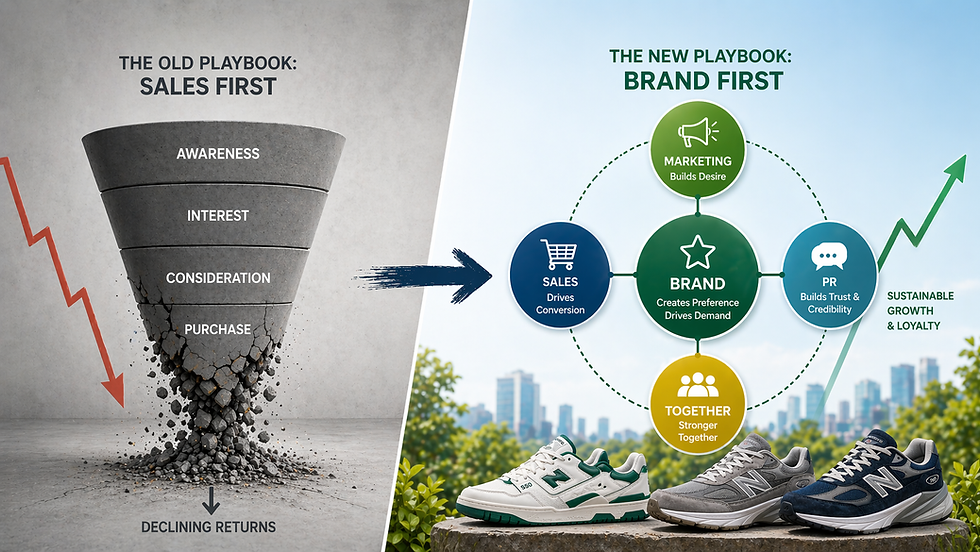
This is where Live Fearless Media lives. Brand, marketing, sales, and PR are not four separate problems with four separate fixes. They are one system. A system does not break in one place. It breaks everywhere you stop paying attention.
When sales flatten, the instinct is to fix sales. Hire a closer. Rewrite the script. Run a promo. When leads drop, the instinct is to fix marketing. Spend more on ads. Redo the funnel. Post more. When the press goes quiet, PR gets a budget. It feels efficient. It is actually the most expensive way to run a business, because every isolated fix is disconnected from what is actually moving, or failing to move, underneath.
After sixteen years of building systems inside businesses of every size, the pattern is almost always the same. The department that looks broken is rarely where the problem lives. The sales team is closing what the brand is making possible. Marketing is generating what the positioning allows. PR is amplifying what the brand has already earned the right to say. When one of those functions starts underperforming, the real answer is almost never a harder push on that one piece. It is a look at what is happening upstream.
New Balance's flip worked because they stopped treating brand as a line item and started treating it as the foundation underneath sales, retail, product, and PR. They did not pull harder on the activation lever. They rebuilt the ground the levers were standing on. By the time the customer was in the store, the decision to buy had already been made somewhere else. That is the whole point. A healthy brand creates demand. Demand creates pricing power. Pricing power creates margin. Margin creates the capacity to keep building the brand. The flywheel is the point. Not the click.
When a business is not growing the way it should, the move is almost never "work the sales team harder." The move is a cascading series of changes across the whole system. Tighten the story. Align the content. Elevate the visibility. Sharpen the positioning. Train the team to speak in the same voice. Let PR catch up to where the brand is headed, not where the brand used to be. Together, those changes create the conditions for the number to move. One lever pull does not change a system. An aligned sequence does.
This is the standard. Brand is not the fun part of the business you delegate to a designer. Brand is the strategy underneath the strategy. The leaders who understand that are the leaders who build companies that scale.
Revenue is the receipt, not the signal. Brand is what tells you what is about to happen.
The Takeaway
There is a version of New Balance's story that gets told in growth circles where the lesson is "brand won." That version is too small. The real lesson is that growth is a system outcome. A CMO who understood the system stopped pulling the wrong lever, got his CEO to back him through eighteen months of uncomfortable quiet, and came out the other side with a brand that could sustain billions in compound growth.
You do not need a 70/30 flip to apply the lesson. You need to look up from the sales dashboard long enough to see what is actually breaking, and whether you are working on the piece of the business that is load-bearing. Sometimes that is the sales team. Often it is the brand. Nearly always, it is the system connecting them.
Visibility is a responsibility. Your brand is an assignment, not a hustle. Clarity converts. Consistency creates authority. Brands that are built to last are built on systems, not sprints.
Ready to Build Yours Like This?
If your business is stuck pulling the same lever and getting smaller returns every quarter, the problem is almost never what it looks like. At Live Fearless Media, we can audit and help you build the full system, brand, marketing, sales, and PR, as one integrated strategy so growth compounds instead of leaks. Book a strategy call at livefearlessmedia.com to discuss what systems and opportunities you should be focusing on in this season of business.


Dạo này mình có thói quen đọc tin bitcoin rồi xem thêm vài góc nhìn phân tích kỹ thuật để nắm nhịp tăng giảm của thị trường crypto từng ngày. Mình thích kiểu có cả bài dự đoán giá kèm cập nhật altcoin, memecoin, vì nhìn tổng quan sẽ dễ hơn trước khi quyết định vào lệnh hay tạm thời đứng ngoài. Thỉnh thoảng mình cũng lướt các chia sẻ trong cộng đồng, nhiều người nhắc nên kết hợp thêm phân tích on-chain và chọn lọc tin vắn để bám sát dữ liệu thực tế. Mình hay ghé https://tapchibitcoin.io/ để cập nhật nhanh rồi tự đối chiếu lại với biểu đồ cho chắc. Với mấy coin lớn như ETH, XRP…
Mình chơi xổ số kiểu giải trí là chính, chủ yếu ngồi xem kết quả cho vui chứ không đặt nặng chuyện đổi đời. Trước đây nghe bạn bè bàn tán đủ loại “cầu” này “cầu” kia nên mình cũng thử theo dõi cho biết. Dần dần thấy có vài chỗ hay lặp lại nên mình chú ý hơn, nhưng vẫn tự nhắc là đừng quá tin. Mỗi lần đọc mấy bài nhận định, mình hay ghi lại vài ý ngắn rồi sau đó so với kết quả để kiểm tra xem có phải mình đang tự hợp lý hóa không. Có hôm trúng chút thì vui, còn sai nhiều thì coi như rút kinh nghiệm. Gần đây mình đọc…
Sc88 hôm bữa mình thấy bạn bè nhắc hoài nên tiện tay vào thử cho biết. Mình chỉ lướt nhanh trang chủ chứ không ngồi đọc kỹ, mà cảm giác đầu tiên là giao diện nhìn sáng và dễ chịu, kiểu chia nội dung theo từng khối nên kéo xuống không bị rối mắt. Có một đoạn giới thiệu tổng quan về thương hiệu đặt khá dễ thấy, đọc vài dòng là nắm được họ đang nói về hệ sinh thái đa dạng với công nghệ hiện đại. Mình cũng thích cách họ đặt tiêu đề rõ ràng, nhìn phát biết phần nào là phần nào, không phải đoán. Bấm qua lại mấy mục trên menu cũng mượt, không bị…